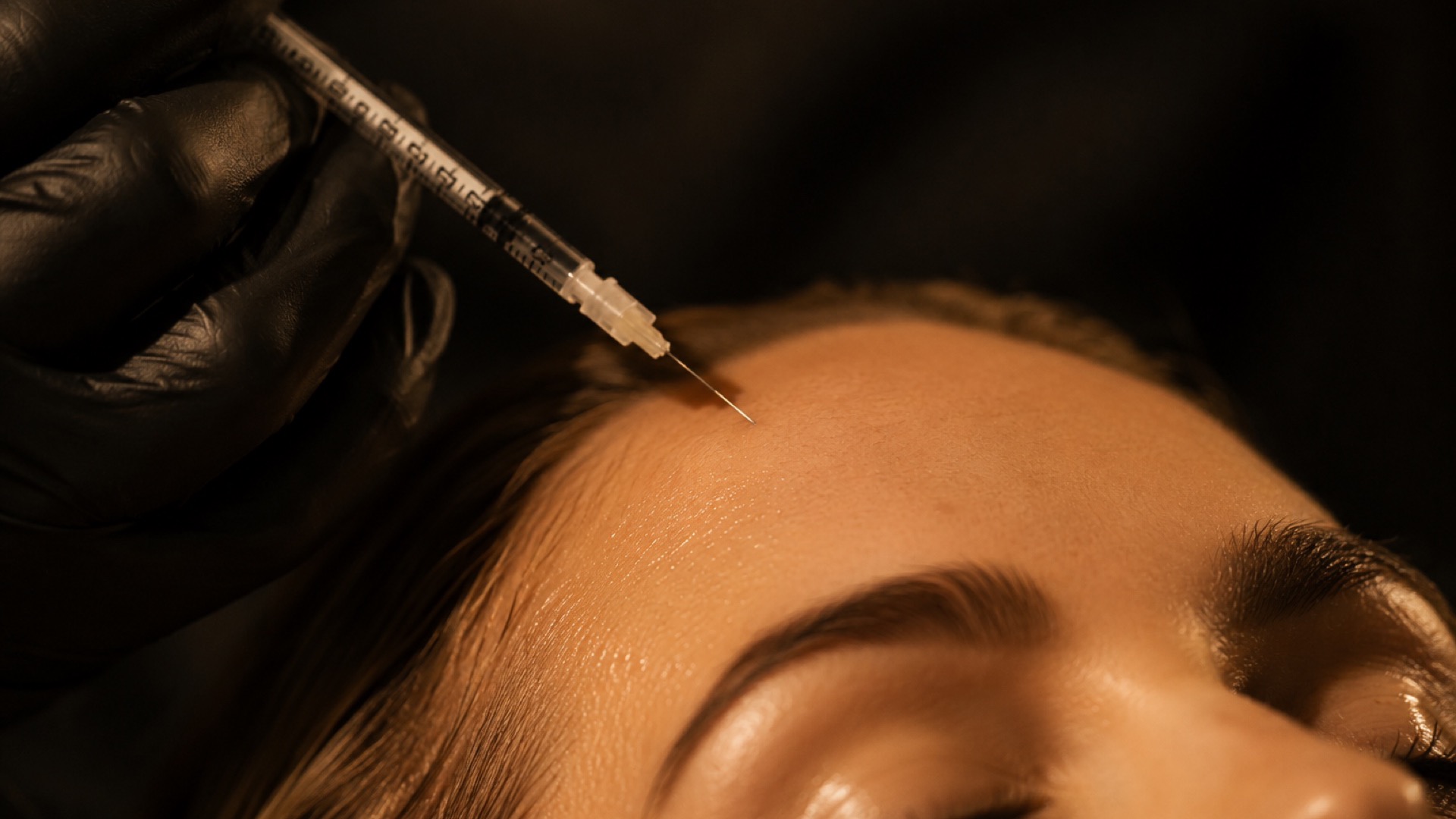
How PRP Hair Restoration Works
PRP (platelet-rich plasma) hair restoration uses your own blood as the treatment. A small sample is drawn, then processed to concentrate the platelets — the components of your blood that carry growth factors and signaling proteins. That concentrated plasma is injected directly into areas of thinning or hair loss along the scalp.
The mechanism is biological rather than pharmaceutical. Growth factors in the plasma — PDGF, VEGF, EGF, IGF-1 — stimulate dormant follicles, encourage the transition from the resting (telogen) phase back to active growth (anagen), and improve blood supply to the follicle bed. The result, for good candidates, is reduced shedding, thicker existing hairs, and in many cases noticeable regrowth within 4–6 months.
PRP is not a cure for hair loss — pattern baldness has a genetic component that continues over time. But it is a clinically supported method for slowing the process and stimulating follicle activity, particularly when treatment begins while follicles are still viable.
The timing principle: PRP works best on follicles that are dormant, not permanently lost. The earlier in the hair loss process you begin, the more follicles you have available to reactivate. Waiting until thinning is severe significantly limits what any treatment can accomplish.
The Concentration Difference: Standard PRP vs. MDbiologix 10x
Not all PRP is the same — and the variation in platelet concentration is the single most important factor in treatment potency. Standard PRP systems centrifuge a blood sample to achieve roughly 3–5x baseline platelet concentration. That is sufficient to produce some growth factor activity, but it is far from the upper threshold of what is clinically achievable.
Industry average
Highest available commercially
At Solace, uses MDbiologix biologics — a clinical-grade PRP system that achieves 10x platelet concentration. This is the highest concentration available on the commercial market. The difference matters because the volume and density of growth factors delivered to each follicle scales with concentration. A 10x concentration system is not incrementally better than 5x — it delivers meaningfully more biological stimulus per injection.
What PRP Hair Restoration Costs in Fort Myers
Pricing across Fort Myers and Southwest Florida for PRP hair restoration:
- Standard PRP systems (3–5x): $800–$1,200 per session
- High-concentration PRP (MDbiologix 10x): $1,200–$1,500 per session
- 3-session initial protocol: $3,000–$4,500 depending on system and provider
- Annual maintenance session: $800–$1,500
At Solace, PRP hair restoration is priced at $1,200 per session. Customized packages based on your consultation are available. The $100 consultation fee is applied toward your first treatment.
How Many Sessions Do You Need?
The standard initial protocol for PRP hair restoration is three sessions spaced 4–6 weeks apart. This gives the follicle stimulation cycle time to complete before the next treatment adds another stimulus layer. Most patients notice reduced shedding during the protocol and begin seeing visible density improvement at the 4–6 month mark.
After the initial protocol, maintenance sessions every 6–12 months help sustain the results. The frequency depends on how active your underlying hair loss is — a younger patient with aggressive pattern loss may need more frequent maintenance than someone with stable, moderate thinning.
Who Is the Right Candidate?
PRP hair restoration is most effective for:
- Men and women with androgenetic alopecia (pattern hair loss), Norwood scale I–V for men, Ludwig scale I–II for women
- Patients experiencing diffuse thinning across the crown or temples where follicles are still present but inactive
- Those who have tried OTC options (minoxidil, DHT-blocking shampoos) without sufficient results
- Patients who want a non-pharmaceutical, biology-based approach
PRP is less effective when:
- Hair loss has been complete in the treated area for several years
- The patient has a condition causing scarring alopecia (which destroys follicles)
- There is an unaddressed hormonal or nutritional cause that has not been assessed
Our licensed provider's includes reviewing blood work and hormones before recommending a PRP protocol. Addressing underlying contributors — thyroid function, ferritin, DHT levels — alongside PRP produces significantly better outcomes than PRP in isolation.
Is It Worth the Cost?
The math on PRP depends on what you are comparing it against. Surgical hair transplants in Florida typically cost $8,000–$20,000 and require significant downtime. Pharmaceutical options (finasteride, minoxidil) have side effect profiles and ongoing cost indefinitely. PRP involves no pharmaceutical side effects, no downtime, and uses your own biology.
For patients in early to moderate stages of hair loss who have active follicles to stimulate, PRP with high-concentration biologics is one of the most clinically supported non-surgical options available. The $1,200 per session cost at Solace reflects the quality of the MDbiologix system — not a premium for its own sake.
Questions about whether you are a good candidate for PRP hair restoration? our licensed provider's consultation includes a scalp assessment and a frank conversation about expected outcomes based on your specific pattern and timeline.
For clinical reference: Platelet-rich plasma for androgenetic alopecia — National Institutes of Health.